
Artificial Intelligence (AI) is a powerful tool emerging at a breakneck speed with potential to bring time-saving efficiency to a growing number of business processes. This month I experimented with AI to help me quickly generate a concept-design for a bracket that will attach an inverter to a battery bank in several of our upcoming solar-PV installations.
What might have taken hours for multiple specialists (a CAD engineer + graphic designer) took only a few minutes of prompt-engineering. The results:
- a buildable 2D drawing,
- a complete 3D model,
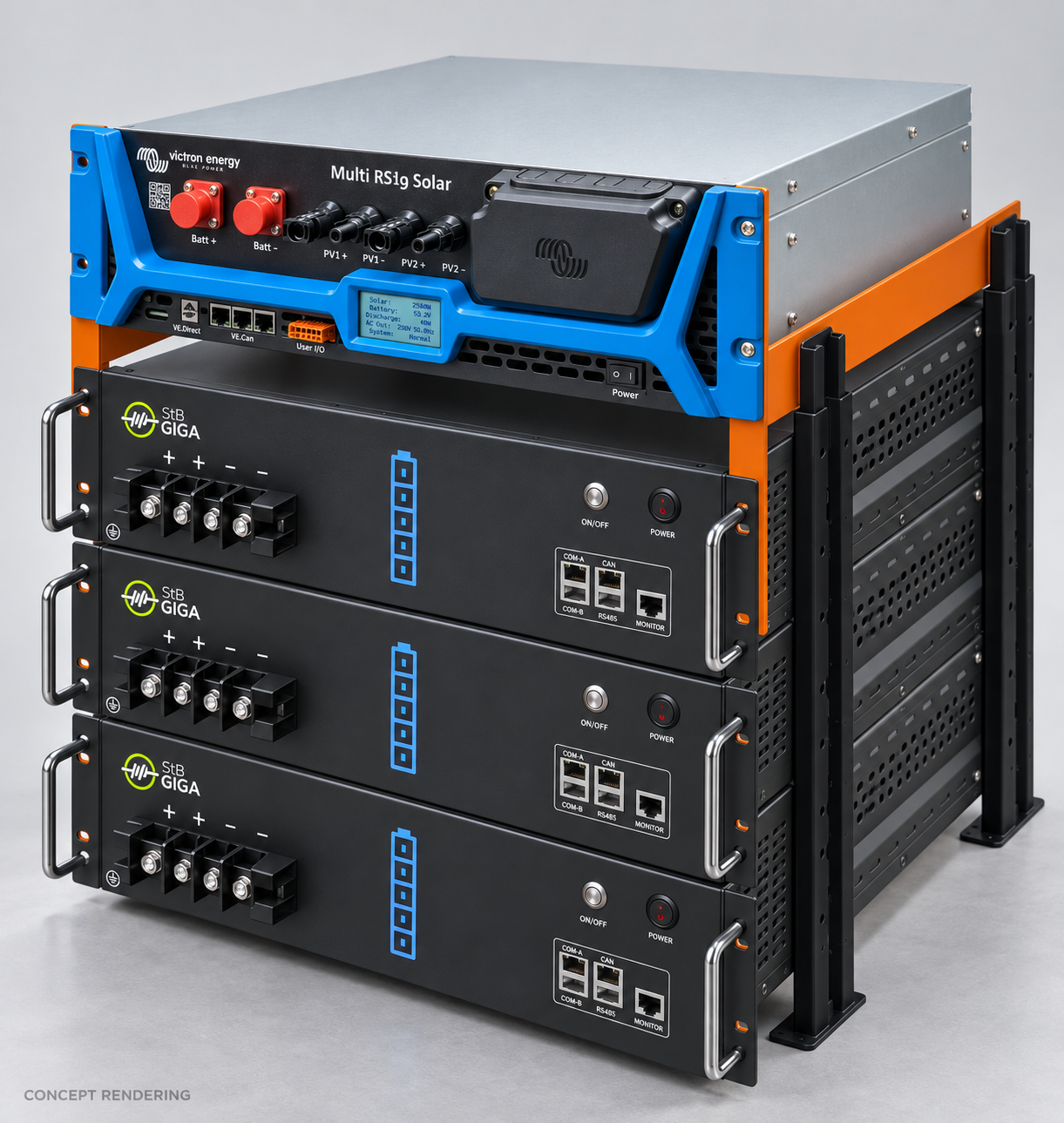
- and beautiful concept images
The whole process took less time than I spent writing this blog post. And I’m impressed with the results.
Why did I need a ‘bracket’ for our solar-PV installations and why use AI for the concept-design?
The answer to the first question is necessity – the part I needed was not available in the market. The answer to the second question was efficiency (time and cost savings).
Why did I need a ‘bracket’?
The type of battery that PT NSP is deploying in most of our designs is a 5kWh LFP, server-rack (19”) style battery that has become a commodity in power backup applications. Our battery manufacturer of choice – StB Giga – has developed an efficient ‘rack-less’ mounting system where each battery can be attached to another battery via small metal clips, allowing a stack of batteries to be quickly assembled with a very small footprint (as no external cabinet or ‘rack’ is necessary).
The inverter we deploy with these batteries is a brand new product from Victron – the RS19. The inverter was only released a few months ago. It also has an exciting footprint and pairs nicely with the StB Giga Flex 5, in that the inverter can be mounted directly into a standard 19” server rack system. But because our batteries employ a ‘rack-less’ stacking system, I needed a way (a ‘bracket’) to attach the inverter to the battery stack. No off-the-shelf solution exists.

Why use AI?
PT NSP is a start-up. The volume of our deployments is still very low. At our stage, it’s overkill to pay a CAD technician and graphic designer hundreds (or thousands) of dollars to carefully engineer a bracket that might only cost a few dollars to fabricate. Until we are ready to manufacture thousands of these inexpensive brackets, we just need to quickly build a prototype. The return on investment to fully-engineer this type of simple piece of metal requires a scale that we are years away from achieving. Instead of a fully-engineered solution, I needed a ‘concept-engineered’ solution – something that is close enough to reality that a welder in Papua, Indonesia can build it and allow me to make quick iterations of it in the physical world. AI is the ideal solution for quickly moving this bracket from idea to a concept-design.
How did I do it?
Prompt-engineering (including visual prompts).
Just feeding text into an LLM (large language model) like ChatGPT was going to be tedious – but LLMs can digest far more than just text. I provided links to the manufacturers’ documentation (user manuals that included product dimensions), images of the inverter and battery, and I was even able to obtain a CAD model of the battery and attachments from StB Giga (thanks He Gang!). Armed with the images, documents, and 3D model, I ‘discussed’ the problem and solution with the LLM (in processes like this, I require the LLM to ‘ask’ me a series of clarifying questions, to ensure alignment before building anything).
Only after a healthy amount of back-and-forth between me and the AI did I request the chatbot to go and build the solution. At this stage, ChatGPT needed 10+ minutes to ‘compute’ while I went and worked on a different task and checked back later. I used ChatGPT’s ‘plus’ subscription set to Codex’s GPT-sol 6.1 ‘light’ for the initial text & image digestion, and then I toggled the LLM up to ‘medium’ and ‘high’ for the iterative generation process. My ‘plus’ subscription has usage limits that I need to monitor in order to avoid reaching subscription limits too quickly. Toggling between ‘light’ and ‘high’ – only using the ‘hungrier’ (higher performing) settings when needed – was an important part of the prompt-engineering process.
It felt extremely empowering for me, the founder of a small start-up, to be able to quickly take an idea to where I can now fabricate a prototype. I can’t wait to see how AI can save me time (and money) next month!